
Brewery Plant Equipment Catalogue
Complete process solutions from grain intake to packaged beer
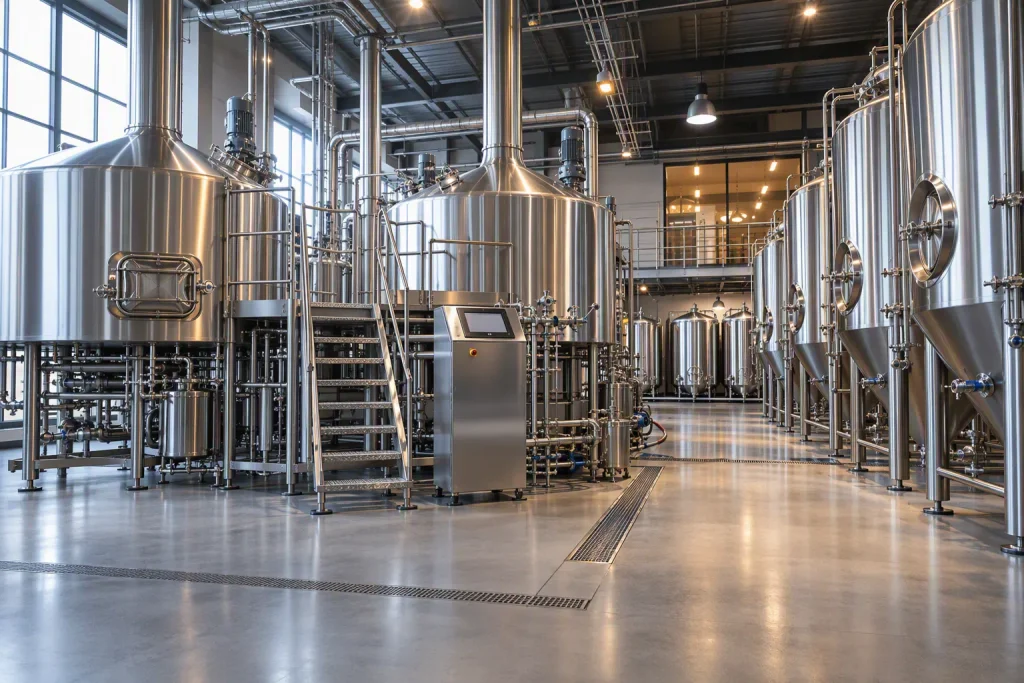
Catalogue overview. This catalogue presents a modular equipment range for brewpubs, craft breweries and regional production plants. Systems may be configured for manual, semi-automatic or fully automated operation. Final vessel capacities, utilities, materials, finishes, pressure ratings and compliance documentation should be confirmed during engineering.
1. Plant Selection Guide
| Plant class | Typical brew length | Recommended use | Typical automation |
| Taproom / pilot | 2–10 hL | Recipe development and local draught sales | Manual or assisted |
| Craft production | 10–40 hL | Mixed keg, can and bottle distribution | Semi-automatic |
| Regional brewery | 40–200+ hL | High-volume, multi-shift production | Central PLC / recipe control |
2. Malt Handling and Milling
2.1 Malt Intake and Storage
Food-grade malt silos, bag-break stations, flexible or chain-disc conveyors, bucket elevators, magnets and dust-control assemblies provide safe, consistent grain transfer. Modular layouts support indoor or outdoor silos and direct-to-mill feeding.
2.2 Malt Mill
Two-, four- or six-roller mills produce a controlled grist profile while protecting husk integrity. Options include adjustable roll gaps, explosion-relief provisions, local extraction, weighing, grist cases and automated feed control.
Selection data: malt throughput, grist specification, available footprint, dust zoning, conveying distance and required level of automation.
3. Brewhouse Systems
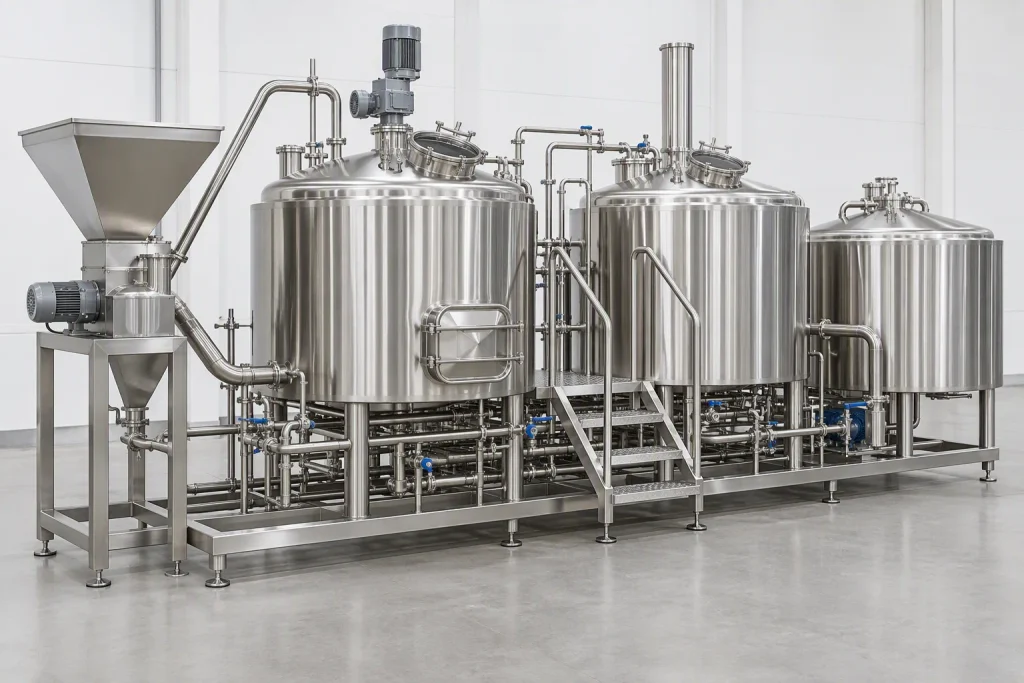
3.1 Mash Mixer / Mash Tun
Insulated vessel for controlled grist hydration and enzymatic conversion. Available with steam, hot-water or electric heating; variable-speed agitation; temperature probes; spray devices; and automated step-mashing recipes.
3.2 Lauter Tun
Designed for wort separation with wedge-wire false bottom, adjustable rakes, spent-grain discharge and controlled sparging. Differential-pressure monitoring and variable-speed drives help protect extract yield and runoff clarity.
3.3 Brew Kettle
Atmospheric or low-pressure boiling vessel with internal or external calandria options. Features can include vapour condenser, hop dosing, level control and energy-recovery interfaces.
3.4 Whirlpool
Tangential wort inlet promotes a compact trub cone and clear wort draw-off. Integrated cleaning heads and adjustable outlet levels support repeatable transfer.
3.5 Hot and Cold Liquor Tanks
Insulated utility-water vessels maintain brewing and cleaning water at controlled temperatures. Packages may include recirculation, level control, heat recovery and dedicated transfer pumps.
4. Wort Cooling, Aeration and Yeast
4.1 Plate Heat Exchanger
Single- or two-stage sanitary heat exchangers rapidly cool wort while enabling hot-water recovery. Skids can include temperature control, bypass, flow indication and cleanable product connections.
4.2 Wort Aeration Assembly
Inline sterile-air or oxygen dosing with flow control, sanitary non-return protection and optional dissolved-oxygen measurement supports consistent yeast performance.
4.3 Yeast Propagation and Storage
Jacketed propagation and storage vessels provide controlled yeast growth, collection and pitching. Typical accessories include agitators, sterile-air filters, sample valves and local temperature control.
5. Fermentation and Maturation
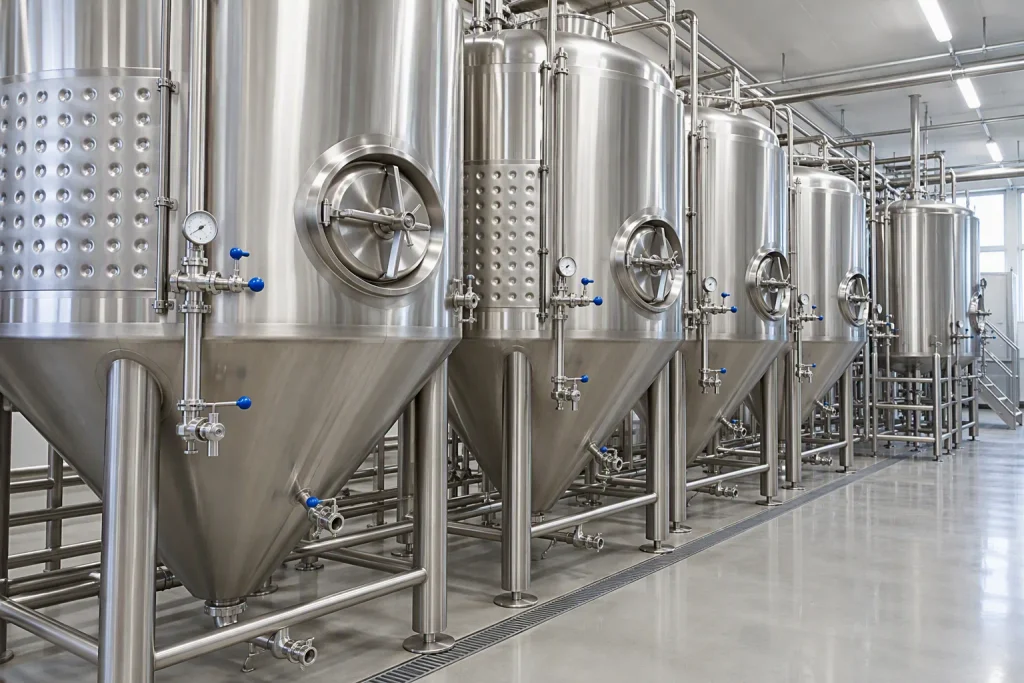
5.1 Unitank Fermenters
Jacketed cylindroconical vessels support fermentation, conditioning and carbonation in one tank. Standard provisions include cooling zones, insulation, pressure/vacuum protection, CIP arm, sample valve, racking port and dry-hop access.
5.2 Horizontal or Vertical Maturation Tanks
Purpose-built tanks provide stable low-temperature maturation where extended lagering or cellar-space efficiency is required.
5.3 Bright Beer Tanks
Pressure-rated, jacketed vessels receive filtered or conditioned beer before packaging. Carbonation stones, level indication and sanitary outlet geometry protect consistency and package yield.
Common options: side manway, top manway, load cells, electronic pressure control, hop dosing, automated valves and central cellar monitoring.
6. Clarification, Filtration and Carbonation
6.1 Centrifuge or Separator
High-speed clarification reduces yeast and solids loading while preserving beer character. Skids can integrate turbidity control, automatic discharge and production/CIP modes.
6.2 Sheet, Cartridge or Kieselguhr Filtration
Scalable filtration options address polishing, sterile filtration or traditional depth filtration. Equipment selection depends on product style, throughput, labour and required microbiological stability.
6.3 Carbonation and Blending Skid
Inline or in-tank carbonation packages regulate gas addition against temperature, pressure and flow. Optional blending, deaerated-water dosing and dissolved-oxygen monitoring support repeatable specifications.
6.4 Sanitary Pumps and Hose Stations
Centrifugal and positive-displacement pumps are selected for product, yeast, CIP and high-viscosity duties. Hygienic manifolds and hose stations simplify routing and reduce cross-connection risk.
7. Cleaning-in-Place and Hygiene
Mobile or central CIP systems are available with one to four tanks for water, caustic, acid and recovery duties. Packages can include electric or steam heating, conductivity-based chemical recovery, recipe control, return monitoring and automatic valve manifolds.
Supporting hygiene equipment: foam-cleaning stations, boot and hand sanitation, hygienic drains, spray balls or rotary jet heads, chemical dosing and safely segregated storage.
8. Utilities and Automation
8.1 Glycol Chilling
Air- or water-cooled chillers, buffer tanks, pumps and insulated distribution headers maintain stable cellar temperatures. Duty/standby pumping and staged capacity are available for resilient operation.
8.2 Steam, Hot Water and Electric Heating
Steam boilers, electric steam generators or direct electric elements are engineered to suit capacity, local services and energy strategy. Condensate recovery and heat-reuse options improve efficiency.
8.3 Compressed Air, CO₂ and Nitrogen
Oil-free or food-grade compressed-air packages serve valves and packaging equipment. Beverage-gas systems can include bulk storage, vaporizers, regulators, distribution rings and nitrogen generation.
8.4 Water Treatment
Filtration, softening, activated carbon, reverse osmosis, ultraviolet treatment and deaeration can be combined to match source-water composition and beer style.
8.5 Process Control
Control platforms range from local panels to full PLC/SCADA systems with recipe management, batch records, alarms, trend data and remote support. Instrument packages may include flow, pressure, temperature, level, conductivity, turbidity and dissolved-oxygen measurement.
9. Packaging Systems
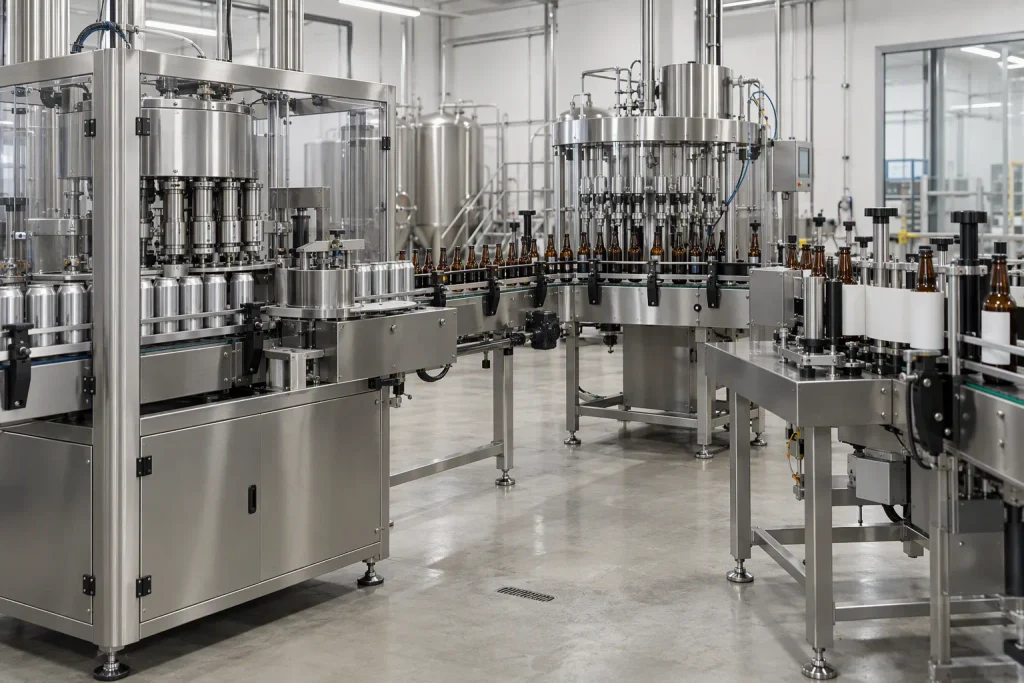
9.1 Keg Washing and Filling
Manual, semi-automatic and fully automatic systems handle external rinsing, caustic cleaning, steam or hot-water sterilisation, purging and counter-pressure filling. Formats can support common spear types and keg sizes.
9.2 Canning
Compact to high-speed lines combine depalletising or feed tables, rinsing, counter-pressure filling, seaming, date coding, labelling and pack-out. Low-oxygen product paths and foam-control features limit pickup.
9.3 Bottling
Rinser-filler-capper monoblocs are available for crown cap, swing-top or other specified closures. Optional pasteurisation, inspection and automated case packing can be integrated.
9.4 Labelling and Secondary Packaging
Pressure-sensitive or wet-glue labellers, date coders, conveyors, accumulation tables, carton erectors, tray packers and shrink wrappers complete the line.
10. Laboratory, Safety and Ancillary Equipment
10.1 Quality-Control Laboratory
Core equipment may include microscopes, incubators, pH meters, density meters, dissolved-oxygen meters, spectrophotometers, balances, ATP hygiene testers and sample-conditioning tools.
10.2 Safety Systems
Plant design should address confined spaces, hot surfaces, pressure systems, chemical handling, dust risk, gas detection, ventilation, guarding, access platforms, emergency stops, lockout provisions and safe drainage.
10.3 Ancillary Equipment
Options include hop dosing vessels, dry-hop systems, yeast brink, mobile tanks, spent-grain handling, keg and crate conveyors, hygienic platforms, heat exchangers, steam traps, valves, fittings, hoses and spare-parts kits.
11. Engineering and Project Delivery
Services can cover process design, equipment sizing, 3D layout, utility schedules, automation philosophy, fabrication, factory acceptance testing, installation supervision, commissioning, operator training and lifecycle support.
Information Required for a Proposal
- Target annual production and brew length
- Beer styles, fermentation profile and product mix
- Preferred package formats and line speed
- Number of brews per day and operating shifts
- Available building dimensions, floor loading and drainage
- Electrical supply, water analysis, fuel and refrigeration availability
- National codes, pressure-vessel requirements and hygiene standards
- Desired automation level, reporting and remote-access requirements
Important: Images are illustrative. Equipment appearance and configuration vary by project. Capacities in this catalogue are indicative; final performance, dimensions, utility consumption and compliance scope are defined in the approved technical proposal.