
Integrated Equipment Catalogue • From Fresh Fruit to Finished Pack
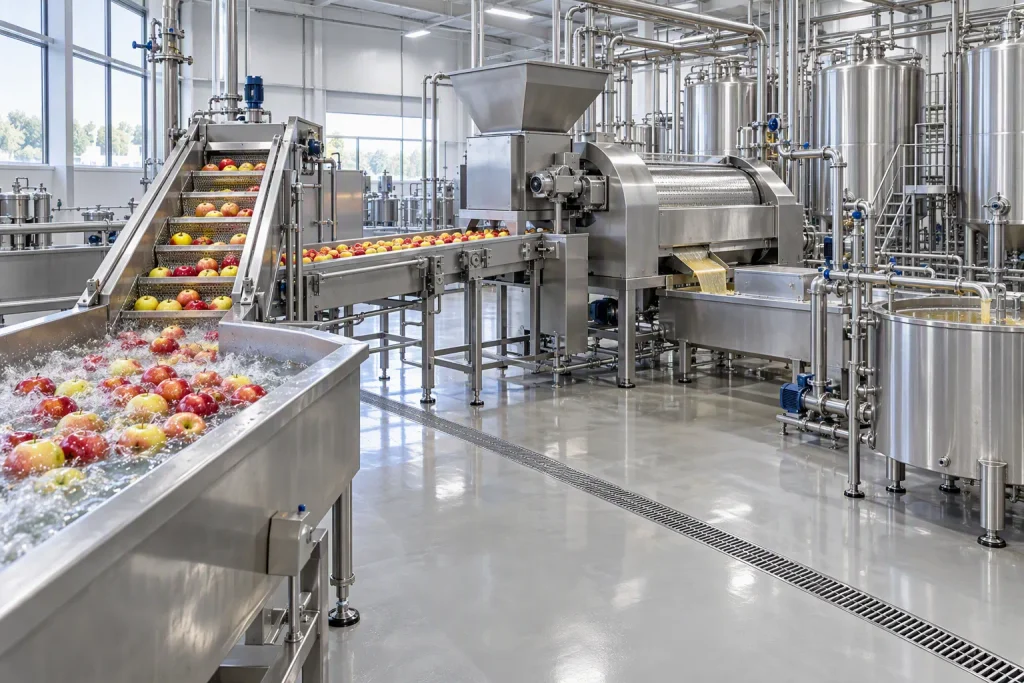
Complete hygienic processing line for fruit reception, extraction, treatment and storage.
Plant Overview
This catalogue presents a modular juice processing plant concept for apple, orange, mango, pineapple and similar fruits. Equipment can be configured as a compact batch line or an integrated continuous system. Final selection, capacity and materials should be confirmed against the fruit type, product specification, packaging format, utility supply and local food-safety requirements.
Typical process flow: Fruit reception → washing and sorting → crushing or pulping → juice extraction → screening and clarification → blending → pasteurisation → aseptic or hygienic holding → filling, capping, labelling and packing.
Equipment Catalogue
| Equipment | Function | Typical Features |
| Fruit Receiving Hopper | Buffers incoming fruit and provides controlled feed to the line. | Food-contact stainless steel, adjustable discharge and wash-down construction. |
| Bubble Washer & Elevator | Removes soil and debris, then transfers fruit to inspection. | Water circulation, air agitation, spray rinse and variable-speed conveyor. |
| Inspection & Sorting Conveyor | Provides a controlled area for visual sorting and rejection. | Food-grade belt or roller bed, side platforms and speed control. |
| Crusher / Pulper | Reduces fruit to a suitable mash or pulp for extraction. | Replaceable screens, guarded drive and cleanable product chamber. |
| Belt Press / Juice Extractor | Separates juice from pomace with controlled pressure. | Continuous operation, wash system, adjustable pressing zone and juice tray. |
| Finisher / Filter | Removes coarse fibre and refines product texture. | Interchangeable screen sizes and sanitary connections. |
| Blend & Balance Tanks | Stores, mixes and balances product flow between stages. | Agitator options, level control, insulated versions and clean-in-place spray device. |
| Pasteuriser | Applies a validated thermal process for product safety and shelf-life objectives. | Plate or tubular design, automatic temperature control, holding section and diversion logic. |
| Filler, Capper & Labeller | Fills and closes containers, then applies product labels. | Container change parts, no-container/no-fill logic, guarding and conveyor integration. |
| CIP System | Circulates cleaning solutions through tanks, pipes and process equipment. | Detergent tanks, dosing, heating, conductivity monitoring and recipe control options. |
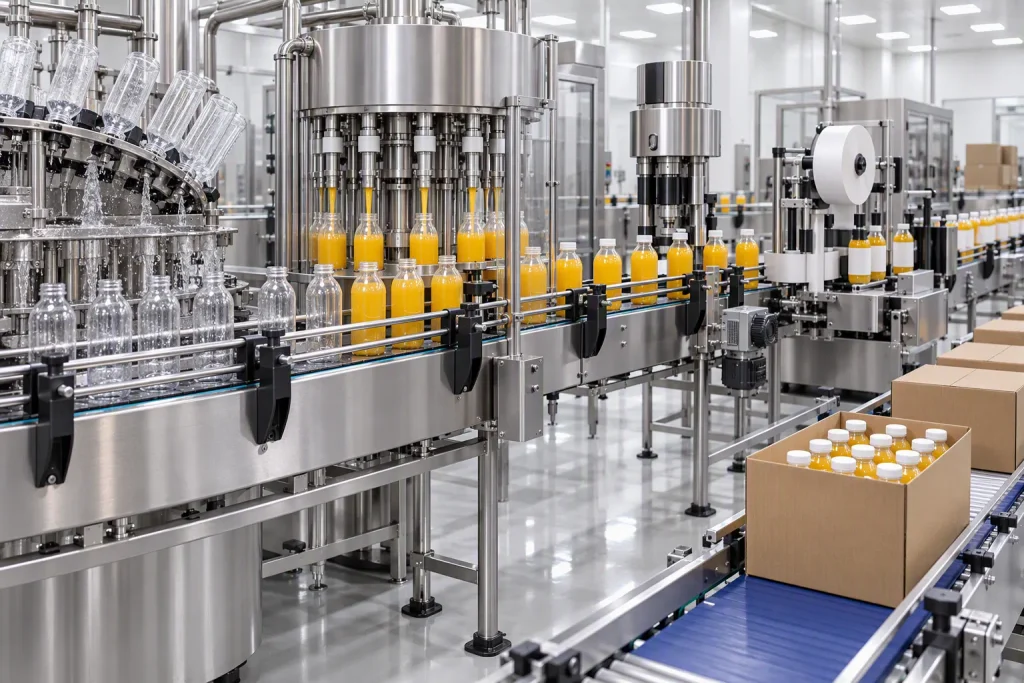
Integrated bottling and secondary packaging line for retail-ready juice products.
System Configuration
- Capacity: Specify fruit intake and finished-product output by hour or shift; actual yield varies by fruit condition and extraction method.
- Product contact: Select food-grade stainless steel and compatible seals according to product acidity, cleaning chemistry and local regulations.
- Automation: Choose manual, semi-automatic or PLC-controlled operation with recipe, alarm and production-data options.
- Packaging: Confirm bottle or carton material, fill volume, closure, label type, coding and case format.
- Expansion: Reserve space and utility capacity for future tanks, fillers or additional product formats.
Utilities & Hygiene
Typical utilities: Potable water, electrical power, compressed air, steam or hot water, chilled water where required, drainage and ventilation. Utility loads must be calculated for the final equipment selection and production schedule. Hygienic layout should provide cleanable surfaces, segregated raw and finished-product zones, safe access, controlled drainage and documented cleaning procedures.
Request a Tailored Proposal
For equipment sizing and a commercial proposal, provide: fruit type and seasonal availability; required input and output capacity; target juice style and shelf life; packaging format and fill volume; available utilities; applicable standards; installation location; preferred automation level; and planned operating hours.