
Pasteurised Milk Storage Tank Catalogue
Hygienic stainless-steel storage solutions for chilled pasteurised milk handling, buffering, and transfer.
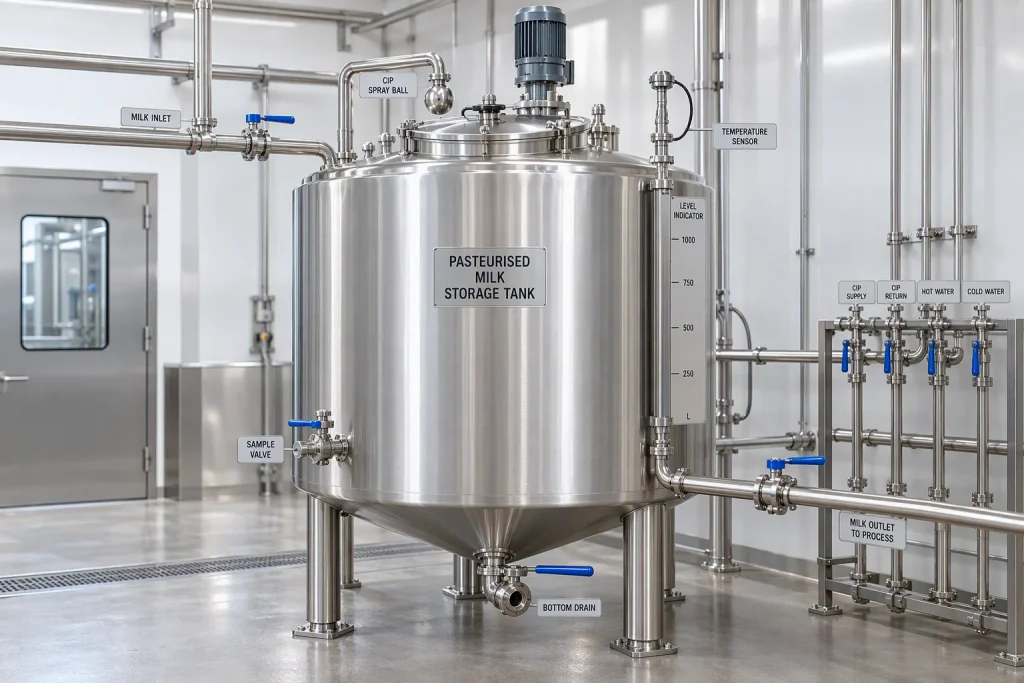
Product Overview
These pasteurised milk storage tanks are designed for dairy plants that require hygienic holding, stable chilled storage, gentle agitation, and easy clean-in-place operation. Typical dairy storage tanks use stainless-steel wetted surfaces, insulation, temperature monitoring, and complete drainage to protect product quality between pasteurisation and filling or further processing. Storage tanks are commonly used as intermediate or finished-product holding tanks in dairy processing, with stainless-steel inner surfaces, insulation, jacket options, and controlled drainage depending on the application.
Catalogue Models
| Model | Capacity | Recommended Use | Description |
| PMST-500 | 500 L | Small dairy, pilot plant, batch holding | Compact insulated vertical tank with hygienic outlet, sampling valve, lid/manway, and CIP spray ball connection. |
| PMST-1000 | 1,000 L | Milk collection centre or small pasteurisation line | Food-grade stainless-steel storage tank with slow-speed agitator, sloped bottom, level indication, and chilled holding capability. |
| PMST-3000 | 3,000 L | Medium dairy processing and filling buffer | Insulated storage vessel with sanitary inlet/outlet manifold, temperature probe, CIP return, air vent, and bottom drain. |
| PMST-5000 | 5,000 L | Industrial pasteurised milk holding before packaging | High-capacity tank with robust support legs, optional cooling jacket, integrated cleaning coverage, hygienic valves, and process control readiness. |
| PMST-10000+ | 10,000 L and above | Large dairy plant, central buffer storage, dispatch preparation | Custom vertical or horizontal tank with access ladder, platform options, multiple inlet/outlet ports, automated valve manifold, and plant-wide CIP integration. |
Standard Tank Description
- Material: Food-grade SS304 stainless steel as standard; SS316L optional for aggressive cleaning regimes or special plant requirements.
- Construction: Vertical or horizontal insulated design with polished internal surfaces to support hygienic cleaning and reduced residue build-up.
- Insulation: Polyurethane foam or mineral wool insulation to maintain chilled product temperature and reduce energy loss. Milk storage tanks are commonly specified with AISI 304 or AISI 316 stainless steel, polished internal surfaces, polyurethane or rock-wool insulation, and accessories such as digital thermometer, level indicator, sampling valve, air vent, and manhole cover.
- Agitation: Slow-speed sanitary agitator to maintain milk homogeneity without excessive foaming or product damage.
- Drainage: Sloped or conical bottom for full product drainage and reduced dead zones.
- Cleaning: CIP spray ball or rotary cleaning device for internal wash coverage without manual entry.
Piping and Valve Arrangement
| Connection / Line | Purpose | Typical Components |
| Milk inlet line | Receives pasteurised milk from pasteuriser or balance tank. | Sanitary pipework, hygienic butterfly valve, non-return valve, flowmeter option. |
| Milk outlet line | Transfers chilled pasteurised milk to filling, packaging, or process use. | Bottom outlet, hygienic pump, butterfly valve, pressure gauge, sampling point. |
| CIP supply line | Feeds cleaning solution to spray ball for internal tank cleaning. | CIP valve, spray ball, pressure/flow verification point, return interlock option. |
| CIP return / drain line | Returns cleaning solution and rinse water to CIP skid or drain. | Bottom drain, sanitary valve, drain trap, conductivity/temperature monitoring option. |
| Vent / air filter | Allows safe pressure equalisation while reducing contamination risk. | Sanitary vent, sterile air filter option, vacuum/pressure relief valve. |
| Utility jacket line | Optional chilled water/glycol circulation for temperature control. | Jacket inlet/outlet, control valve, temperature controller, insulation cladding. |
Technical Specification Guide
| Parameter | Standard Offering | Optional Upgrade |
| Capacity range | 500 L to 10,000 L | Custom capacity above 10,000 L |
| Tank orientation | Vertical | Horizontal or silo configuration |
| Material | SS304 stainless steel | SS316L stainless steel |
| Internal finish | Polished hygienic finish | Mirror polish/passivated finish |
| Temperature holding | Insulated chilled storage | Cooling jacket with glycol/chilled-water circulation |
| Cleaning | CIP spray ball | Rotary jet cleaner or automated CIP valve matrix |
| Instrumentation | Temperature indicator, level indicator, sample valve | Load cells, PLC integration, data logging, alarms |
Recommended Accessories
- Sanitary centrifugal product pump with variable speed control.
- Automated valve manifold for product transfer and CIP routing.
- Inline temperature transmitter and high/low temperature alarm.
- Level transmitter, sight glass, or load-cell weighing system.
- Access ladder and service platform for larger tanks.
- Hygienic sampling valve for quality checks.
- Sterile vent filter and pressure/vacuum relief protection.
- Bottom drain valve with drainability-focused installation.
Application Notes
For pasteurised milk service, the tank should be installed in a hygienic area with segregated raw and treated product routes, drainable pipework, validated CIP coverage, and reliable chilled-water or glycol utilities where active cooling is required. Dairy plant design guidance commonly emphasises sanitary stainless piping, CIP circuits, refrigeration continuity, hygienic zoning, and drainable pipework as core requirements for safe milk handling. Dairy plant designs typically coordinate sanitary piping, CIP circuits, refrigeration, hygienic zoning, and drainability within the process layout.