
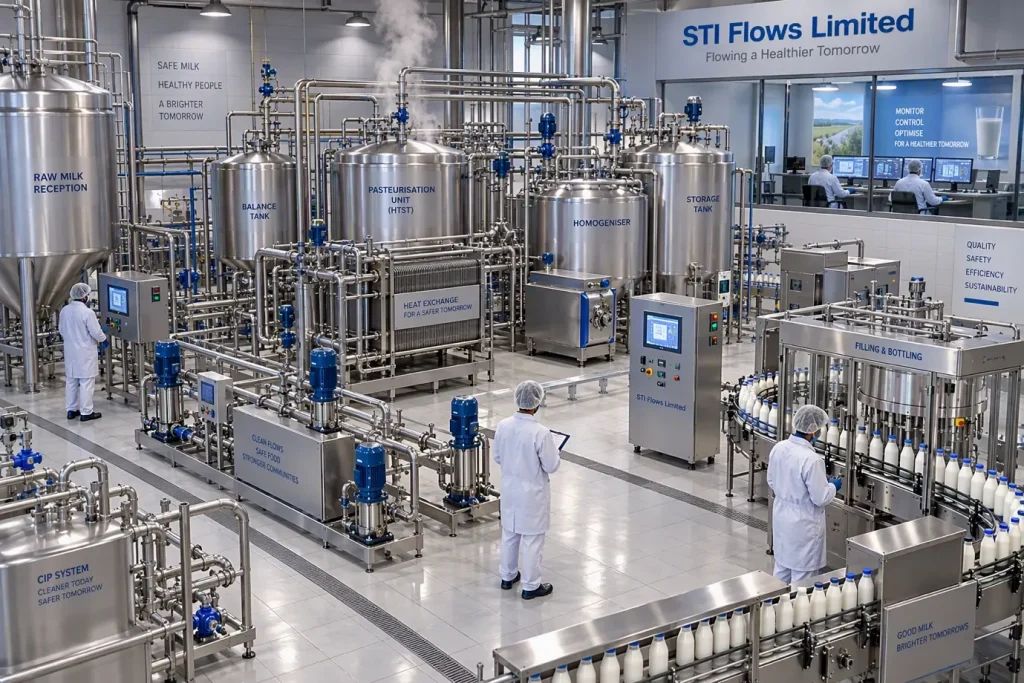
Complete Dairy Processing Plant Equipment Catalogue
From raw milk reception to hygienic filling, packaging, utilities and environmental services
1. Catalogue Purpose and Design Basis 1
2. Milk Reception and Raw Milk Handling 2
3. Separation, Standardisation and Pasteurisation 2
4. Product Processing Modules 3
5. Filling, Packing and Finished-Goods Handling 3
6. Cleaning-in-Place and Hygiene Systems 4
7. Utility and Service Plant 4
8. Drainage, Wastewater and By-product Handling 6
9. Automation, Quality Control and Traceability 6
10. Procurement, Documentation and Project Delivery 6
1. Catalogue Purpose and Design Basis
| Project design data to be confirmed before equipment selection | |
| Parameter | Typical catalogue range / requirement |
| Raw milk intake | 5,000–250,000 litres/day; road tanker, churn or both |
| Processing rate | 1,000–50,000 litres/hour per line |
| Products | Pasteurised milk, cream, cultured products, ESL milk, UHT milk and product variants |
| Operating pattern | Single, double or continuous shift; seasonal peak capacity stated separately |
| Packaging | HDPE/PET bottles, cartons, pouches, cups, bag-in-box or bulk containers |
| Hygienic standard | Food-grade product-contact materials, drainable design and validated CIP |
| Product-contact material | Normally stainless steel 316L; non-contact frames normally 304 |
| Controls | PLC/HMI, recipes, batch records, alarms, trends and production reporting |
2. Milk Reception and Raw Milk Handling
| Equipment | Function and principal features | Typical options |
| Tanker reception bay | Weather-protected unloading point with kerbing, drainage, hose rack, earthing and traffic protection | One or multiple bays; access platform; tanker top-sampling station |
| Raw milk sampling station | Representative sample collection for temperature, antibiotics, acidity, fat, protein, density and microbiology checks | Automatic sampler; barcode/LIMS link |
| Reception strainer/filter | Removes gross foreign matter before pumping | Duplex filter, automatic changeover, differential-pressure indication |
| Unloading pump set | Hygienic centrifugal or positive-displacement transfer from tanker | Variable-speed drive, dry-run protection, duty/standby arrangement |
| Air eliminator and flowmeter | Removes entrained air and records accepted milk quantity | Mass or electromagnetic meter; legal-for-trade package where required |
| Inline reception cooler | Plate heat exchanger cools incoming milk to storage temperature | Chilled-water or glycol circuit; heat recovery |
| Raw milk silos/tanks | Insulated storage with top-entry or side-entry agitator, level and temperature measurement | 10–300 m³; load cells; high-level protection; aseptic vent filter |
| Reception valve manifold | Routes milk to selected silo and separates product from CIP return | Mix-proof valves; automated line proving |
3. Separation, Standardisation and Pasteurisation
| Equipment | Duty | Key specification points |
| Balance tank | Maintains constant feed and provides low-level protection | Hygienic design, spray device, level control and overflow protection |
| Regenerative plate heat exchanger | Preheats, pasteurises, cools and recovers energy | Multi-section frame, food-grade gaskets, differential-pressure control |
| Clarifier/separator | Removes sediment and separates skim milk and cream | Self-cleaning bowl, automatic solids discharge, vibration monitoring |
| Automatic standardisation unit | Controls milk fat and cream concentration to recipe | Flow, density and fat measurement with closed-loop control |
| Homogeniser | Reduces fat globule size and stabilises product | One- or two-stage; product-pressure monitoring; pulsation damping |
| Holding tube | Provides validated legal holding time at pasteurisation temperature | Fixed geometry; calculated minimum flow condition |
| Flow-diversion assembly | Diverts under-processed milk away from forward flow | Independent temperature verification, fail-safe valve position and event record |
| Pasteurised milk buffer tank | Decouples pasteuriser from filling line | Closed hygienic tank, filtered vent, gentle agitation and short residence time |
| Hot-water set | Provides stable pasteurisation heating medium | Steam-to-water exchanger, circulation pump, expansion vessel and controls |
4. Product Processing Modules
| Module | Included plant |
| Pasteurised drinking milk | Standardisation, homogenisation, HTST pasteurisation, chilled buffer storage and direct feed to filler |
| Cream | Cream balance tank, standardisation, pasteuriser, optional homogeniser, ageing tank and filler feed |
| Fermented milk/yoghurt | Mix tank, powder induction, high-heat treatment, homogeniser, fermentation tanks, cooling, fruit dosing and cup/bottle filling feed |
| ESL milk | Enhanced microbial reduction, high-temperature processing, hygienic surge tanks and ultra-clean filling interface |
| UHT milk | Direct or indirect UHT system, deaeration where required, aseptic homogeniser, aseptic tanks and sterile transfer |
| Flavoured milk | Sugar/syrup preparation, powder induction, filtration, blending, stabiliser hydration and thermal processing |
| Recombined milk | Water treatment, powder handling, high-shear mixing, fat melting/dosing, hydration tanks and standardisation |
5. Filling, Packing and Finished-Goods Handling
| Equipment | Application and options |
| Container infeed | Depalletiser, unscrambler, bottle blower, carton magazine or pouch-film unwind |
| Container treatment | Air rinse, water rinse, chemical sterilisation or UV treatment according to hygiene class |
| Filler-capper/sealer | Volumetric, mass-flow, level or time-pressure filling; clean, ultra-clean or aseptic execution |
| Closure handling | Cap elevator/sorter, cap sterilisation, torque monitoring, foil sealing or carton closure |
| Product recovery interface | Hygienic filler bowl/headers, return routing, product-water interface control and drain collection |
| Inspection | Fill-level, cap presence, seal integrity, label, date code, barcode and foreign-body checks |
| Labelling and coding | Pressure-sensitive, sleeve or wraparound label; batch/date coding and vision verification |
| Secondary packaging | Tray packer, wraparound case packer, shrink bundler, carton former and sealer |
| Palletising | Robotic or conventional palletiser, pallet dispenser, layer-pad handling and stretch wrapper |
| Conveyors | Low-pressure accumulation, product changeover, line control and hygienic drainage |
| Cold store interface | Pallet transfer, racking interface, warehouse labelling and dispatch staging |
6. Cleaning-in-Place and Hygiene Systems
| System | Scope |
| Central CIP station | Water, caustic, acid and recovery tanks; dosing; heating; supply/return pumps; strainers and conductivity control |
| CIP circuits | Dedicated or shared circuits for reception, tanks, pasteuriser, product lines, fillers and ancillary skids |
| Single-use CIP | Compact make-up and return unit for high-risk, low-frequency or segregated duties |
| Valve manifolds | Mix-proof routing with leakage chambers, seat-lift cleaning and position feedback |
| Tank cleaning devices | Static spray balls or rotary jet heads sized for vessel geometry and soil load |
| Chemical storage | Bunded bulk/IBC storage, transfer pumps, locked dosing area, eyewash and ventilation provisions |
| Hygiene stations | Boot wash, hand wash/sanitise, controlled personnel entry and cleaning-equipment storage |
| CIP validation instrumentation | Time, temperature, conductivity, flow and return-turbidity recording with recipe reports |
7. Utility and Service Plant
| Service | Typical plant and distribution | Critical design considerations |
| Potable/process water | Break tank, booster pumps, filtration, softener, activated carbon, UV and optional reverse osmosis | Local water quality, hygienic storage, residual disinfectant, sampling and backflow prevention |
| Boiler and steam | Boiler, feed tank, water treatment, chemical dosing, blowdown vessel, condensate return and steam headers | Food-grade culinary steam where directly contacting product; pressure regulation and trap management |
| Hot water | Steam or heat-pump generation, insulated storage, circulation loops and temperature control | Pasteuriser, CIP and wash-down demand diversity |
| Chilled water/glycol | Chillers, buffer tank, pumps, plate exchanger, glycol make-up and insulated distribution | Peak cooling load, low-temperature protection, redundancy and heat recovery |
| Refrigeration | Ammonia, CO₂ or HFC/HFO package, compressors, condensers, evaporators and safety detection | Refrigerant regulation, machinery-room ventilation, relief discharge and competent maintenance |
| Compressed air | Oil-free or food-grade compressor, receiver, dryer, filters and ring main | Separate instrument and process-air quality classes; dew point and condensate management |
| Electrical power | Transformer, main LV switchboard, motor control centres, variable-speed drives, UPS and standby generator | Load schedule, discrimination, harmonics, hygienic enclosure rating and emergency supplies |
| Process gases | Nitrogen/CO₂ storage or generation, pressure regulation, sterile filtration and distribution | Food-grade certification, monitoring, ventilation and asphyxiation risk controls |
| Ventilation/HVAC | Air handling units, filtration, heating/cooling, extraction and pressure zoning | Positive pressure in high-care areas, condensation control and cleanable duct terminals |
| Vacuum | Liquid-ring or dry vacuum package with receiver and distribution | Filler, deaerator and process duty; hygienic separation from product |
| Fire and life safety | Detection, alarm, hydrants, sprinklers, extinguishers, emergency lighting and evacuation systems | Site risk assessment, local code and hazardous chemical/refrigerant areas |
| Workshop and maintenance | Maintenance shop, spares store, lifting equipment, lubrication control and calibration bench | Food-safe segregation, controlled tools and critical-spares strategy |
8. Drainage, Wastewater and By-product Handling
| System | Catalogue scope |
| Hygienic process drainage | Stainless channels, trapped gullies, screened sumps, segregated storm/process networks and cleanout access |
| Product-loss recovery | Interface detection, first-rinse segregation, milk recovery tank and controlled rework or disposal |
| Wastewater pre-treatment | Screening, flow balancing, pH correction, dissolved-air flotation and sludge dewatering |
| Biological treatment | Aerobic, anaerobic or combined treatment selected for flow, COD/BOD and discharge consent |
| Odour control | Covered tanks, ventilation extraction and carbon/biofilter treatment where required |
| Solid waste | Segregated packaging waste, rejected product containment, compactors and secure waste area |
| Energy recovery | Heat recovery from refrigeration, condensate and process streams; optional biogas utilisation |
9. Automation, Quality Control and Traceability
| Area | Minimum recommended scope |
| Plant automation | PLC architecture, local and central HMIs, recipe control, valve/pump interlocks, route management and alarm handling |
| Data and reporting | Batch genealogy, tank history, pasteurisation records, CIP reports, downtime, yields and utility consumption |
| Instrumentation | Calibrated flow, level, pressure, temperature, conductivity, turbidity, density and analytical measurement |
| Laboratory | Milk analyser, pH meter, balances, incubators, antibiotic test equipment, microbiology facilities and sample refrigeration |
| In-process quality | Defined sampling points, rapid tests, filler checks, environmental monitoring and release controls |
| Traceability | Raw-milk lot through process tanks, ingredients, packaging batches, finished product and dispatch |
| Cybersecurity | Role-based access, backups, network segregation, secure remote support and change control |
10. Procurement, Documentation and Project Delivery
| Deliverable | Required content |
| Process design package | Process description, mass and energy balance, equipment list, PFDs, P&IDs and utility summary |
| Equipment documentation | Datasheets, general arrangements, materials, certificates, weld records, manuals and spare-parts lists |
| Electrical and controls | Load list, single-line diagram, I/O list, network architecture, control narrative, software backup and licences |
| Installation | Battery limits, foundations, pipe supports, access platforms, insulation, cabling, drains and hygienic finishes |
| Testing | Factory acceptance test, installation checks, water trials, product trials, performance test and acceptance criteria |
| Validation | Pasteurisation/sterilisation validation, CIP coverage and recipe validation, calibration and traceability challenge |
| Training | Operator, maintenance, laboratory, hygiene and automation training with competency records |
| Handover | As-built drawings, commissioning records, certificates, recommended spares and preventive-maintenance schedule |
10.1 Final Scope Checklist
- Confirm product portfolio, capacities, recipes, shelf-life targets and operating hours.
- Define raw milk quality, tanker sizes, maximum unloading time and storage days.
- Confirm local legal pasteurisation/UHT requirements and product-release criteria.
- Prepare peak electrical, steam, cooling, water, air and wastewater load profiles.
- Agree hygienic zoning, personnel/material flows and environmental conditions.
- Fix equipment battery limits, redundancy philosophy and future expansion allowance.
- Confirm package formats, nominal speeds, changeover times and line efficiencies.
- Perform food-safety, process, chemical, pressure, electrical, refrigeration and fire risk assessments.
- Agree performance guarantees for capacity, yield, energy, water, product losses and cleanability.
- Complete site survey and multidisciplinary detailed design before purchase or construction.
Engineering note: This catalogue is a complete functional scope template, not a final equipment quotation. Capacities, hygienic class, materials, statutory requirements, utilities, redundancy and acceptance criteria must be confirmed for the intended country, site and product portfolio by qualified process, mechanical, electrical, food-safety and environmental specialists.