
Complete Production-Line Catalogue • From Raw Materials to Finished Pallet
Process, equipment and quality-control guide
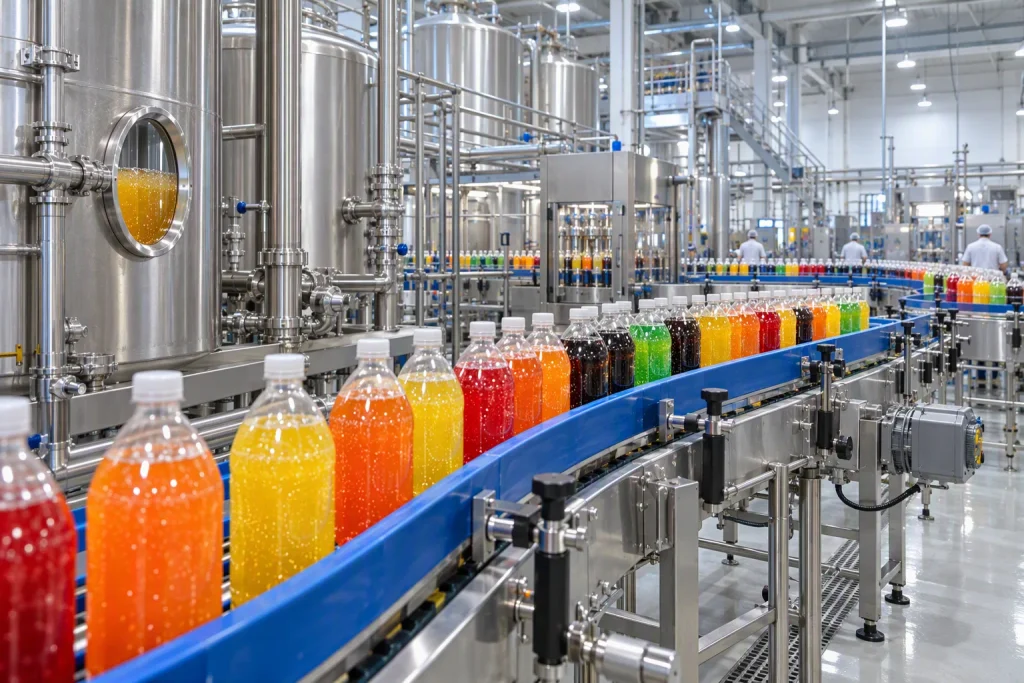
Integrated soft drink processing and PET bottling line — illustrative configuration.
Catalogue Guide
- Plant overview and design basis
- Raw materials and incoming inspection
- Water treatment and syrup preparation
- Blending, carbonation and product holding
- Container preparation, filling and closing
- Labelling, packing, palletising and warehousing
- Cleaning, utilities, quality assurance and safety
- Equipment schedule and typical line options
Scope: Carbonated soft drinks packed in PET bottles. The same core process can be adapted for glass bottles or cans with suitable container-handling and filling equipment.
Plant Overview
A soft drink plant converts treated water, sweetener, flavour concentrate, acidulants and carbon dioxide into a consistent packaged beverage. A hygienic design separates raw-material handling, wet processing, high-care filling and dry warehousing. Product-contact parts are normally food-grade stainless steel, with automated controls used to manage recipes, temperatures, pressures, cleaning cycles and traceability.
Typical process flow
Receiving → Water treatment → Simple syrup → Final syrup → Proportioning → Chilling → Carbonation → Bottle production or depalletising → Rinsing → Filling → Capping → Inspection → Coding → Labelling → Secondary packing → Palletising → Finished-goods storage → Dispatch
Indicative design choices
- Output: Select line speed from target annual volume, package mix and operating hours.
- Packaging: PET, returnable glass, one-way glass or cans require different preparation and filling modules.
- Products: Sugar-sweetened, reduced-sugar and zero-sugar recipes may require segregated ingredient handling and validated changeovers.
- Automation: Manual, semi-automatic or fully automatic operation can be configured around labour, traceability and quality objectives.
Raw Materials and Incoming Inspection
Approved suppliers deliver water-treatment chemicals, sugar or liquid sweetener, concentrates, carbon dioxide, preforms or empty containers, closures, labels, film and cartons. Each lot is identified, quarantined where required, sampled and released against specification.
- Water: Check appearance, odour and relevant chemical and microbiological parameters.
- Sweeteners and concentrates: Verify identity, lot, seal condition, shelf life and certificate of analysis.
- Carbon dioxide: Confirm beverage-grade certification and storage conditions.
- Packaging: Inspect dimensions, cleanliness, print quality and compatibility with line equipment.
Materials are stored according to hazard, temperature, humidity, stock-rotation and allergen-control requirements. All issues and consumption are recorded for lot traceability.
Water Treatment and Syrup Preparation
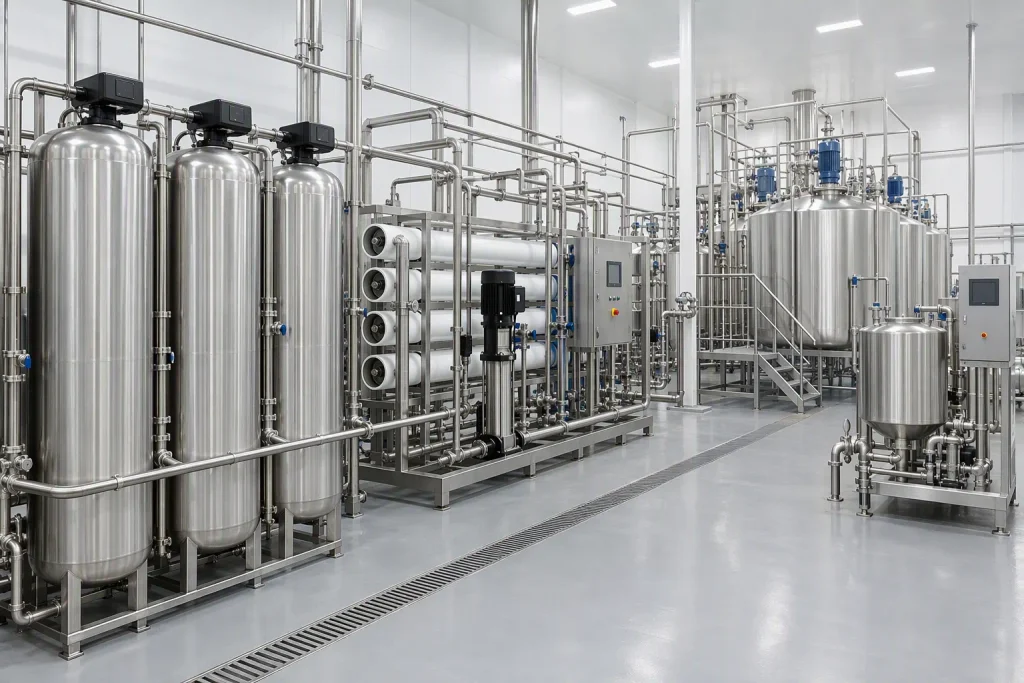
Illustrative water-treatment and syrup-room installation.
Step 1 — Raw-water conditioning
Raw water enters a buffer tank and passes through treatment selected for the source water. A typical train includes coarse filtration, activated-carbon treatment, softening or antiscalant dosing, fine filtration, reverse osmosis where required, and final disinfection. Treated water is stored in a closed sanitary tank and distributed through a hygienic loop.
Step 2 — Simple syrup preparation
Measured treated water is charged to a jacketed dissolving tank. Sugar is added under agitation and dissolved at the validated temperature. The syrup is filtered to remove insoluble matter, cooled if necessary and transferred to a simple-syrup tank.
Step 3 — Final syrup preparation
Concentrate, acidulant, colours, preservatives and other approved ingredients are weighed or metered according to the controlled recipe. They are blended with simple syrup until uniform. The batch is sampled for appearance, aroma, soluble solids, acidity and other product-specific checks before release.
Beverage Blending and Carbonation
Step 4 — Proportioning and blending
Released final syrup and treated water are accurately proportioned to the recipe. An in-line blender or batch tank homogenises the beverage. Instruments monitor flow, ratio, soluble solids and temperature, while the control system records the batch or production run.
Step 5 — Deaeration and chilling
Dissolved air is reduced where required to improve carbonation stability and flavour protection. The beverage is chilled because cold liquid absorbs carbon dioxide more efficiently and reduces foaming during filling.
Step 6 — Carbonation
Beverage-grade carbon dioxide is injected under controlled pressure. The carbonator maintains the specified gas volume through stable temperature, pressure and flow. Product is held briefly in a closed sanitary buffer before transfer to the filler.
In-process release checks
- Soluble solids or recipe ratio
- Acidity or pH, as applicable to the specification
- Temperature and carbonation level
- Appearance, flavour and aroma
- Microbiological status according to the site control plan
Container Preparation, Filling and Closing
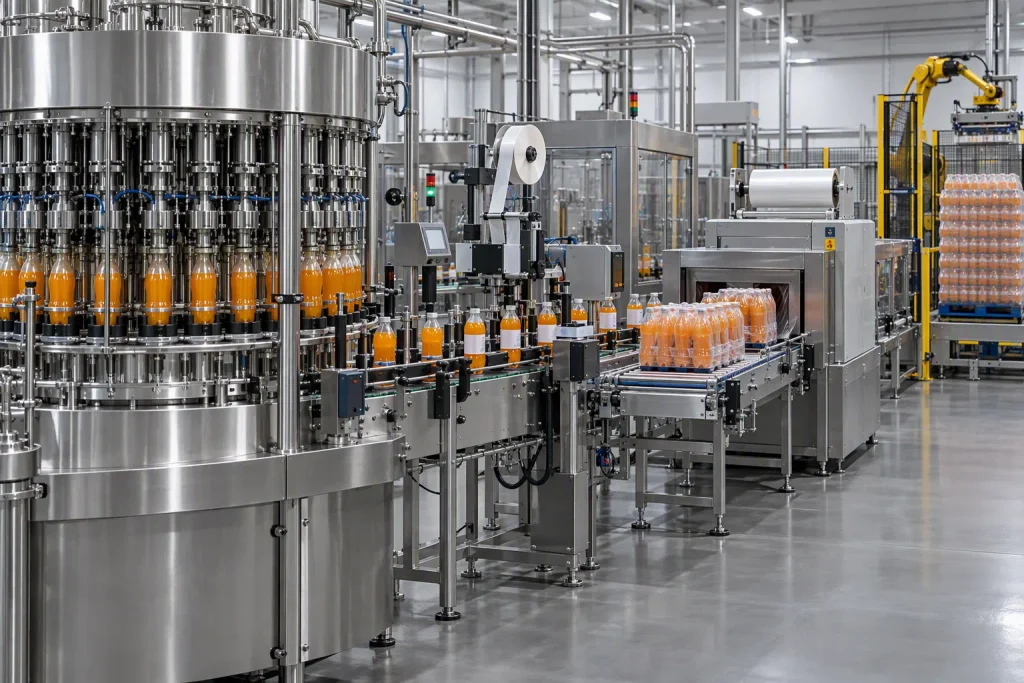
Illustrative filling and end-of-line packaging system.
Step 7 — Bottle supply
PET preforms are fed to a stretch blow-moulder, heated, blown in moulds and transferred by air conveyor. Alternatively, purchased empty bottles are depalletised. Containers are inspected and conveyed to the rinser.
Step 8 — Rinsing
Bottles are inverted or internally rinsed using the validated medium, then drained. The enclosed rinser and transfer minimise recontamination before filling.
Step 9 — Filling
The cold carbonated beverage enters a counter-pressure filler. Bottle pressure is equalised, product is filled to the target level or volume, and pressure is released in a controlled manner to limit foaming and carbon dioxide loss.
Step 10 — Capping and closure inspection
Closures are oriented, applied and tightened to the validated specification. Automated checks reject bottles with missing, high or misapplied caps. Filled containers may also be checked for level, leaks and appearance.
Step 11 — Coding and labelling
A legible batch code and best-before date are applied for traceability. Pressure-sensitive, roll-fed or shrink-sleeve labels are positioned and inspected. Vision systems can confirm code presence, label alignment and product identity.
Step 12 — Secondary packing and palletising
Bottles are collated into trays, cartons or shrink-wrapped multipacks. Packs are inspected, palletised in the approved pattern, stabilised with stretch film and labelled with product, lot and quantity information.
Finished-Goods Control and Dispatch
Step 13 — Final quality release
Quality personnel review production records and test representative samples against the approved specification. Checks may include net content, closure performance, carbonation, soluble solids, acidity, sensory attributes, package integrity, code accuracy and microbiological criteria. Nonconforming product is identified and controlled.
Step 14 — Warehousing
Released pallets are stored in a clean, dry area protected from excessive heat, sunlight, pests and physical damage. Warehouse controls maintain stock identity and first-expired-first-out rotation.
Step 15 — Dispatch
Orders are picked, checked and loaded into clean vehicles. Dispatch records preserve the link between customer, product code, quantity and production lot, enabling rapid traceability and recall if needed.
7. Cleaning, Utilities and Plant Support
Clean-in-place system
A central or local clean-in-place system circulates validated pre-rinse, detergent, intermediate-rinse, sanitising and final-rinse steps through tanks, pipework, blenders, carbonators and fillers. Time, temperature, concentration, flow and conductivity are monitored and recorded. Changeovers include line clearance and allergen controls where applicable.
Core utilities
- Treated process water and potable service water
- Food-grade carbon dioxide supply and safe bulk storage
- Oil-free compressed air, with sterile filtration where product contact is possible
- Chilled water or glycol for beverage cooling
- Steam or hot water for processing and cleaning
- Electrical distribution, standby power strategy and control network
- Drainage, wastewater handling and chemical storage
Quality, hygiene and safety
- Documented food-safety plan, prerequisite programmes and controlled operating procedures
- Zoned hygiene, controlled personnel flow, protective clothing and handwashing facilities
- Machine guarding, interlocks, lockout/tagout and chemical-handling controls
- Calibration, preventive maintenance and spare-parts management
- Batch records, material genealogy, deviations, complaints and recall readiness
Equipment Catalogue
| Typical modules for a complete PET carbonated-soft-drink line | |||
| Process area | Principal equipment | Function | Key selection points |
| Water treatment | Feed tank, filters, carbon unit, softener or dosing, reverse osmosis, ultraviolet or other disinfection, treated-water tank | Produce consistent water suitable for the product and plant | Source-water analysis, recovery, hygiene, automation and reject-water use |
| Syrup room | Sugar dissolver, filter, ingredient station, final-syrup tanks, transfer pumps | Dissolve, meter and blend recipe ingredients | Batch size, heating method, dust control, accuracy and allergen segregation |
| Processing | Proportioner, deaerator, plate heat exchanger, carbonator, product buffer | Blend, chill and carbonate beverage | Recipe range, gas accuracy, turndown, oxygen control and cleanability |
| Bottle making | Preform feeder, heater, stretch blow-moulder, air conveyor | Form PET bottles and deliver them to filling | Bottle sizes, mould changes, air consumption and lightweighting |
| Filling block | Rinser, counter-pressure filler, capper, cap feeder | Prepare, fill and close bottles hygienically | Container range, speed, fill accuracy, foam control and hygienic design |
| Inspection | Empty-bottle, fill-level, cap, code and label inspection systems | Detect and reject nonconforming containers | Defect library, rejection verification, data storage and access control |
| Decoration | Date coder and label applicator | Apply traceability data and product presentation | Label type, changeover, code permanence and vision integration |
| End of line | Pack collator, shrink wrapper or cartoner, conveyors, palletiser, stretch wrapper | Create stable distribution units | Pack formats, pallet patterns, film use, guarding and accumulation |
| Cleaning | CIP tanks, heater, dosing, pumps and return monitoring | Clean and sanitise product-contact circuits | Circuit sizing, chemical recovery, validation data and operator safety |
| Utilities | Air compressors, chiller, boiler or hot-water set, CO₂ system, electrical panels | Supply reliable plant services | Peak demand, efficiency, redundancy, monitoring and future expansion |
Commercial configuration notes
Final equipment sizing should follow confirmed products, container drawings, package formats, required output, source-water analysis, utility availability, local regulations, building layout and sanitation philosophy. Request guaranteed performance data for output, efficiency, product loss, energy use, water use, changeover time and acceptance testing.
Project Definition Checklist
- Target products, recipes and annual production volume
- Container sizes, closures, labels, multipacks and pallet formats
- Required line speed, operating pattern and future expansion allowance
- Raw-water report and available utility capacities
- Desired automation, production reporting and traceability interfaces
- Food-safety, environmental and occupational-safety requirements
- Factory layout, building clearances, drainage and material/personnel flows
- Factory-acceptance, site-acceptance, commissioning and training scope
- Spare parts, service response, warranties and lifecycle support
Result: A correctly specified plant provides a controlled path from approved ingredients to traceable, stable and market-ready soft drinks, while supporting efficient cleaning, safe operation and future product flexibility.
Catalogue note: Images are illustrative. Equipment arrangement and controls must be engineered for the selected products, capacities, packaging formats and applicable regulations.