
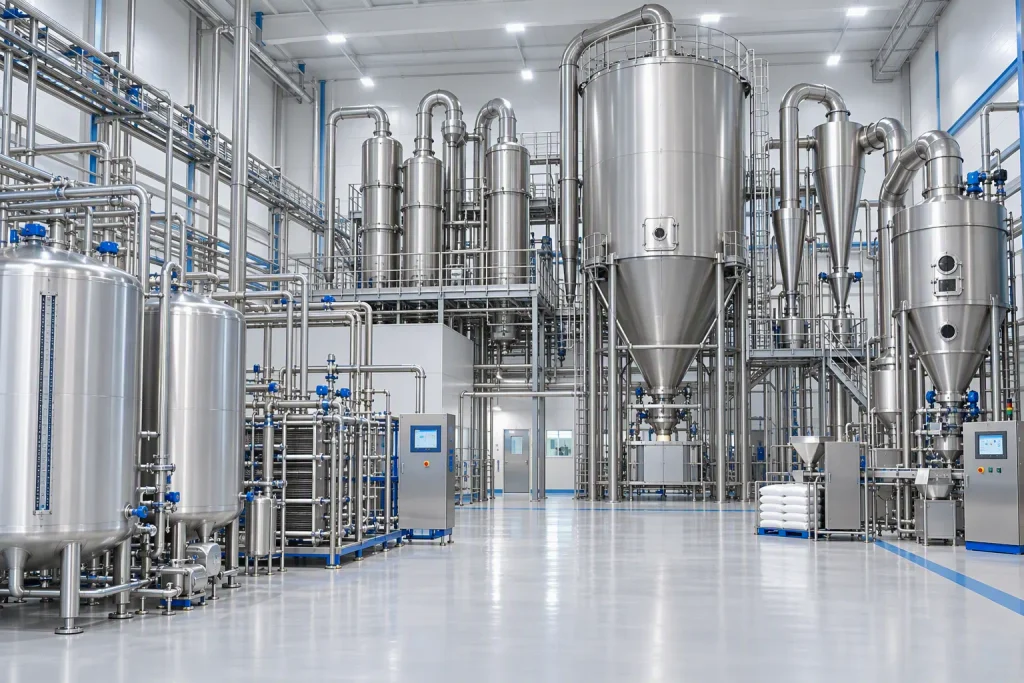
Complete Milk Powder Plant Catalogue
Integrated process line, utilities, automation and project services
1. Plant Overview
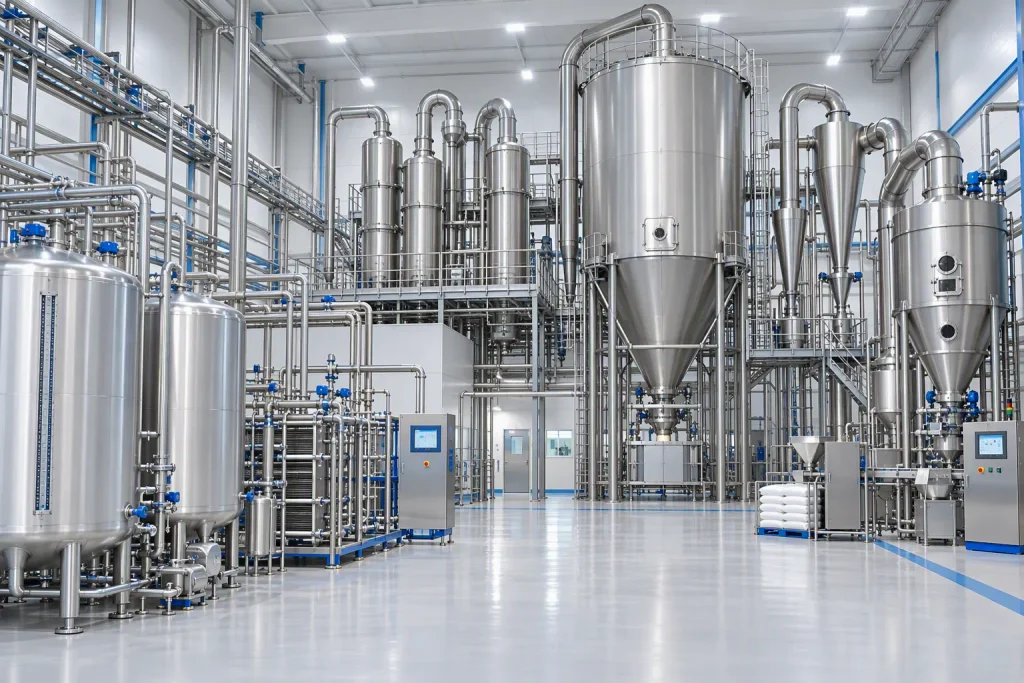
This catalogue presents a complete, hygienic milk powder production plant from raw-milk reception to finished-product packing. The modular design can be configured for whole milk powder, skim milk powder and selected formulated dairy powders. Final capacity, product specification, energy targets and equipment sizes are confirmed during process design.
Typical design range: 1–10 tonnes of powder per hour, with smaller or larger lines available by engineering review.
Supply scope: process equipment, utility packages, automation, installation support, commissioning, operator training and documentation.
2. Process Flow
- Raw milk reception, filtration, weighing and chilled storage
- Clarification, separation and fat standardisation
- Pasteurisation and optional homogenisation
- Multi-effect vacuum evaporation with condensate recovery
- Concentrate balance and high-pressure feed
- Spray drying with primary powder separation
- External fluid-bed final drying and cooling
- Sifting, metal detection and intermediate storage
- Automatic bag filling, sealing, check-weighing and palletising
- Clean-in-place (CIP) and production data recording
3. Main Process Equipment
| Area | Equipment included | Key features |
| Milk reception | Unloading manifold, inline filter, deaerator option, flow meter, reception tank and transfer pumps | Sanitary design, rapid unloading, temperature and volume monitoring |
| Storage and standardisation | Insulated silos, agitators, cream separator, clarifier and blending tanks | Automatic fat/SNF control, gentle product handling |
| Heat treatment | Plate or tubular pasteuriser, holding tube, homogeniser and balance tank | Recipe-controlled temperature, regeneration and diversion protection |
| Evaporation | Falling-film multi-effect evaporator, vapour separator, condenser and vacuum system | High thermal economy, low residence time, hygienic CIP coverage |
| Drying | Feed system, atomiser or nozzle system, air heater, drying chamber, cyclones/bag filter and fluid bed | Controlled moisture, bulk density, solubility and particle size |
| Powder handling | Vibro sifter, pneumatic conveying, magnets, metal detector and powder bins | Low dust, enclosed transfer and foreign-body control |
| Packing | Valve/open-mouth bag filler, nitrogen option, sealer/sewing unit, check-weigher and pallet handling | Typical 10–25 kg bags; retail formats available as an option |
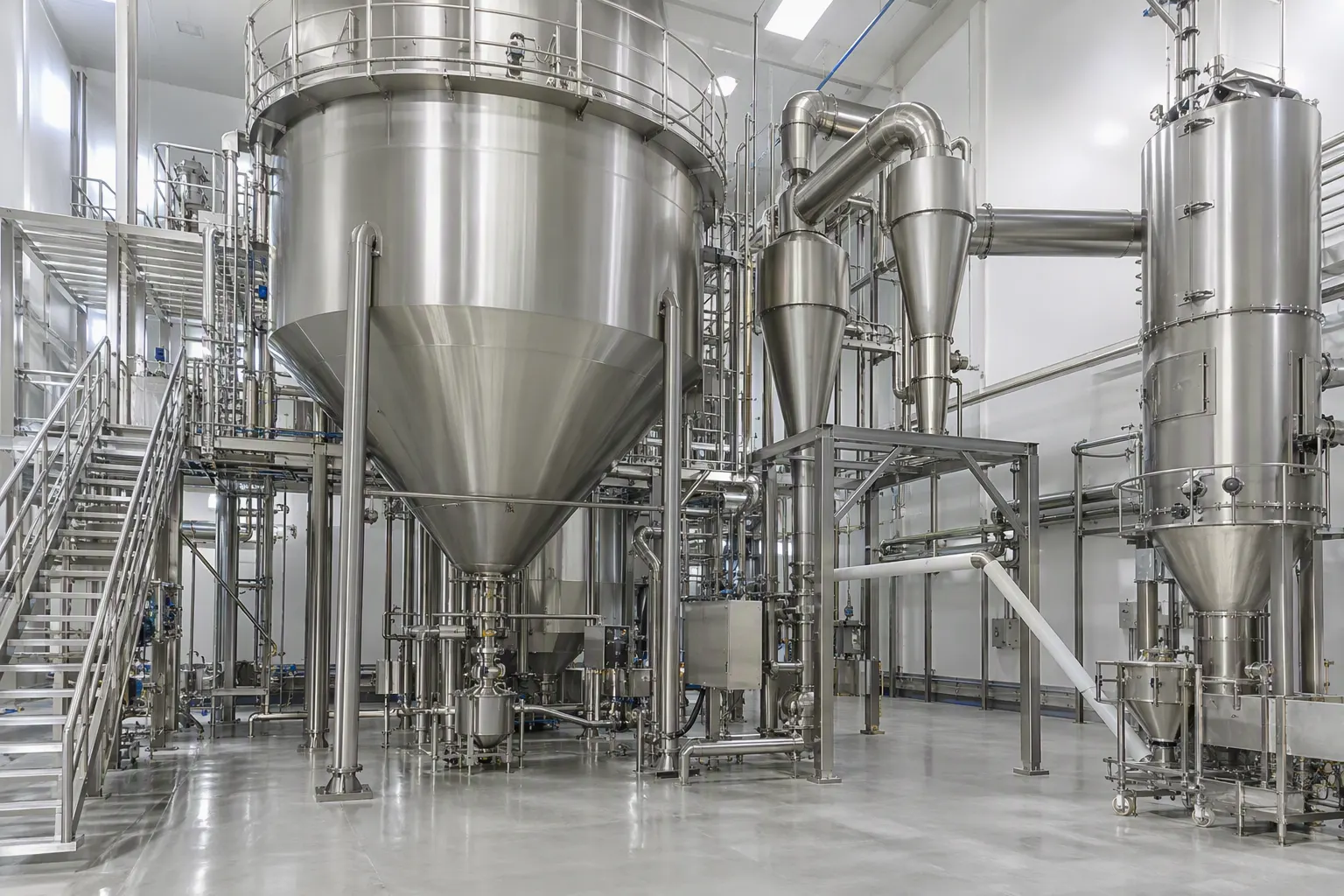
Representative spray-drying and powder-recovery section
4. Complete Utility Systems
| Utility | Package scope | Typical design basis |
| Steam and condensate | Boiler, feed-water tank, chemical dosing, steam header, pressure reduction, traps and condensate return | Process steam for pasteurisation, evaporation, drying-air heating and CIP |
| Water treatment | Raw-water tank, filtration, softener, reverse osmosis, UV/ozone option and treated-water storage | Potable/process water quality defined by local and product requirements |
| Refrigeration | Chiller or ammonia package, chilled-water/glycol pumps, buffer tank and distribution | Milk cooling, process cooling and HVAC loads |
| Cooling water | Cooling tower or closed-circuit cooler, pumps, side-stream filter and dosing | Condenser, compressor and equipment cooling duties |
| Compressed air | Compressors, receiver, filters, refrigerated/desiccant dryer and oil-free final filtration | Instrument air and plant air supplied as separate quality classes where required |
| Electrical power | Transformer interface, MCCs, VFDs, distribution boards, cabling, earthing, UPS and standby-generator interface | Voltage and frequency matched to project location |
| CIP | Multi-tank CIP station, heaters, dosing, return monitoring and route management | Caustic, acid, hot-water and recovery circuits with recipe control |
| HVAC and hygiene | Filtered make-up air, room pressure control, dehumidification option, extraction and personnel hygiene stations | Dryer/packing zoning and condensation control |
| Effluent | Drain segregation, balance tank, pH correction, dissolved-air flotation option and wastewater interface | Load reduction and compliance with local discharge limits |
| Fire and safety | Detection, alarms, hydrant/sprinkler interfaces, dust protection and emergency systems | Final design subject to local code and fire-risk assessment |
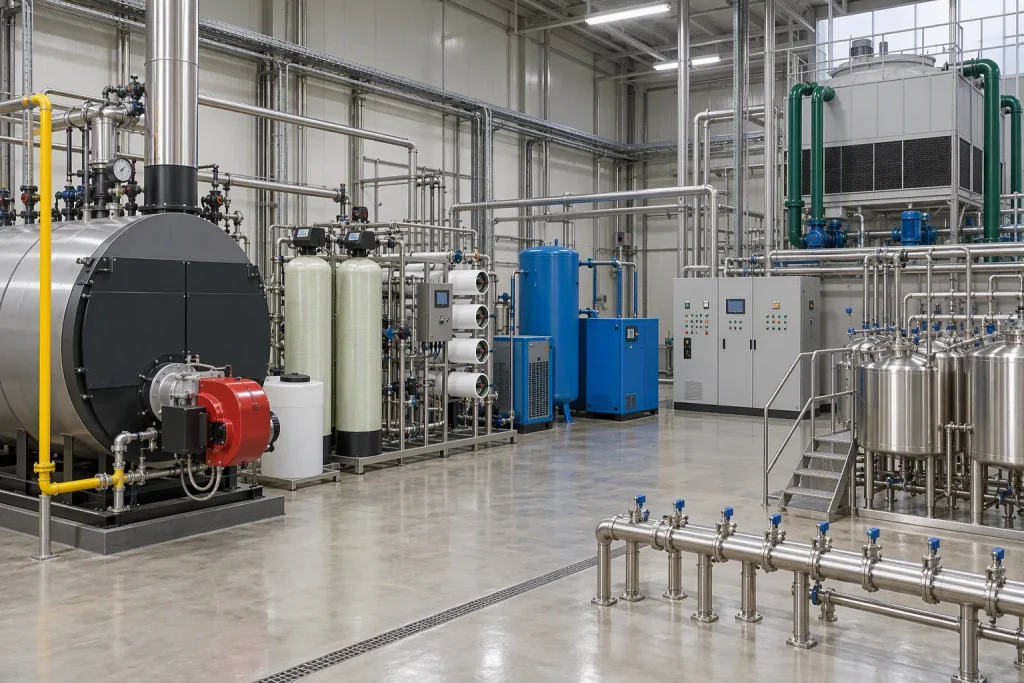
Representative central utility systems
5. Automation and Digital Control
- PLC/SCADA control with graphical process overview and recipe management
- Automatic sequences for start-up, production, shutdown and CIP
- Trend recording for temperature, pressure, flow, conductivity, moisture and energy use
- Batch reporting, alarm history, audit trail and user-access levels
- Remote support interface and optional connection to MES/ERP systems
- Instrumentation selected for hygienic service and maintainability
6. Quality, Hygiene and Safety
- Product-contact parts in food-grade stainless steel with hygienic welds and drainable design
- Validated pasteurisation controls and hygienic separation between raw and treated product zones
- Inline sampling points and laboratory testing provision for moisture, fat, protein, solubility and microbiology
- Powder-zone dust extraction, explosion venting/suppression options and bonded/grounded equipment
- Guarding, interlocks, emergency stops and safe access platforms
- Design aligned with the applicable local food, pressure, electrical, environmental and occupational-safety requirements
7. Performance and Consumption Guide
| Parameter | Catalogue guidance |
| Feed product | Standardised whole or skim milk; formulated dairy liquids by review |
| Powder capacity | Project-specific; typical modular range 1–10 t/h |
| Final moisture | Normally selected to suit the product specification and storage requirements |
| Energy configuration | Conventional multi-effect evaporation, mechanical/thermal vapour recompression options, heat recovery and condensate reuse |
| Cleaning | Automatic CIP circuits with recipe, concentration, temperature, flow and return monitoring |
| Availability target | Defined during project engineering based on operating hours, redundancy and maintenance strategy |
Exact mass balance, utility consumption and equipment sizing require confirmed feed composition, powder specification, production schedule, site conditions and local utility data.
8. Project Delivery Scope
- Concept design, process description, mass and energy balance
- Process flow diagrams, P&IDs, equipment layouts and utility schedules
- Equipment manufacture, factory inspection and packing for shipment
- Site supervision for installation, pre-commissioning and commissioning
- Performance testing against an agreed product and operating basis
- Operator and maintenance training
- Operation manuals, maintenance schedules, spare-parts lists and certificates
Optional Services
- Civil and building design coordination
- Laboratory, warehouse and cold-store packages
- Automatic palletising and warehouse integration
- Energy optimisation and water-reuse study
- Preventive-maintenance agreement and remote technical support
9. Information Required for a Quotation
- Required powder type and hourly/daily capacity
- Raw milk composition, reception temperature and daily availability
- Target powder moisture, fat, protein, bulk density and packaging format
- Operating hours, cleaning philosophy and planned product changeovers
- Available steam/fuel, power, water, cooling and compressed-air conditions
- Site location, ambient conditions, building constraints and applicable codes
- Desired automation level, laboratory scope and project delivery boundary
Catalogue note: The photographs are representative concept visuals. Final equipment arrangement, dimensions, materials, performance guarantees and utility figures are confirmed in the project proposal and approved design documents.