
Milk Ice Cream Production Plant
Complete Equipment Catalogue • Hygienic Processing • Flexible Capacities • Turnkey Line Concept
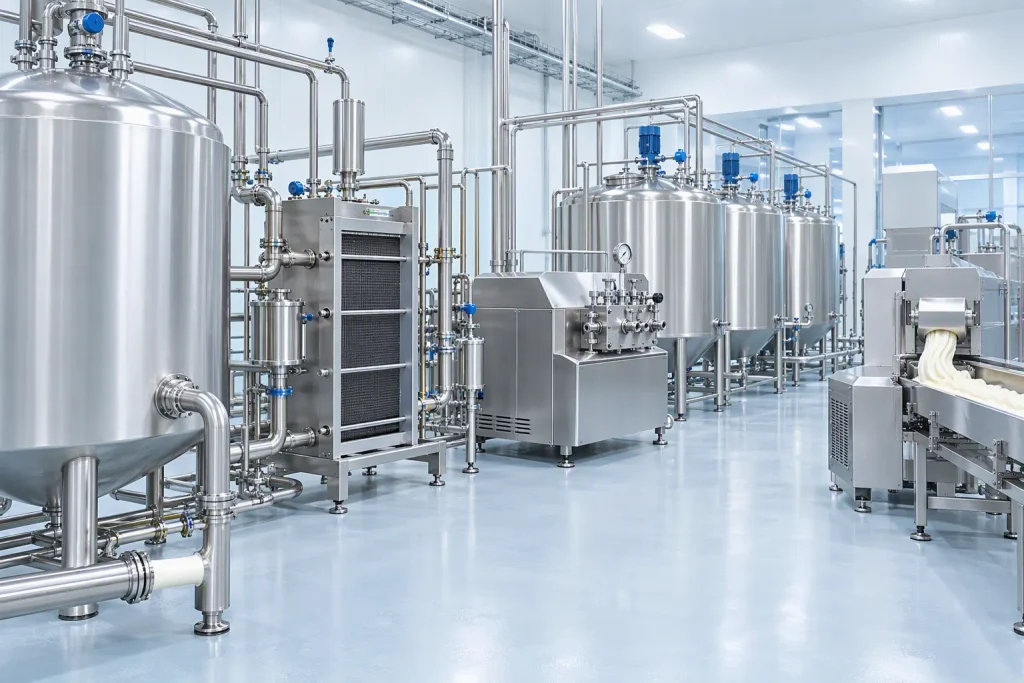
Turnkey Plant Overview
This catalogue presents a modular milk ice cream production line designed to receive, blend, pasteurise, homogenise, age, freeze, fill, harden and store dairy ice cream. Equipment can be configured for artisanal, medium-scale or industrial production. All product-contact parts should be specified in food-grade stainless steel, with hygienic connections and clean-in-place capability where appropriate.
Typical applications: cups, tubs, cones, bulk packs, sticks and ripple or inclusion products.
Indicative design capacities: 300, 500, 1,000, 2,000 and 5,000 litres per hour. Final capacity depends on recipe, overrun, pack format and operating schedule.
Process Flow
- Milk reception and chilled storage
- Ingredient weighing and mix preparation
- Filtration and pasteurisation
- Homogenisation
- Cooling and ageing
- Flavour, colour and inclusion addition
- Continuous freezing and aeration
- Filling, sealing and coding
- Hardening
- Frozen storage and dispatch
| Indicative Plant Packages | |||
| Package | Mix throughput | Best suited to | Typical automation |
| Compact | 300–500 L/h | Start-ups, test kitchens, local brands | Semi-automatic |
| Growth | 1,000–2,000 L/h | Regional manufacturers | Automatic process; flexible packing |
| Industrial | 3,000–5,000 L/h | High-volume multi-format plants | Integrated automatic line |
1. Milk Reception and Mix Preparation
1.1 Milk Reception Tank
Insulated, agitated vessel for receiving and buffering chilled milk. Recommended features include a sanitary manway, spray ball, temperature sensor, level indication, sampling valve and load-cell option.
Typical range: 1,000–20,000 L. Construction: 304 or 316L stainless steel product contact. Options: inline filter, flowmeter, transfer pump and automated valve manifold.
1.2 Ingredient Mixing Tank
Jacketed vessel for dissolving sugar, milk powder, stabiliser and emulsifier into the dairy base. High-shear mixing reduces powder agglomeration and supports consistent hydration.
Typical range: 300–5,000 L/batch. Options: powder hopper, vacuum induction, load cells, recipe control and dual-speed agitator.
1.3 Balance Tank and Sanitary Pumps
Maintains stable feed to thermal processing. Hygienic centrifugal pumps handle low-viscosity mix; positive-displacement pumps are recommended after ageing or for inclusion-rich products.
2. Pasteurisation, Homogenisation and Ageing
2.1 Plate Pasteuriser
Regenerative plate heat exchanger for controlled heating, holding and cooling of the ice cream mix. The system can include flow diversion, automatic temperature recording and hot-water circulation.
Indicative duty: heat to 80–85°C, hold to the validated recipe, then cool to 2–5°C. Actual time and temperature must be set by the food-safety plan and local regulation.
2.2 Two-Stage Homogeniser
Reduces fat globule size to improve emulsion stability, texture and melt resistance. A two-stage arrangement supports smooth body while limiting clustering.
Typical pressure: 120–200 bar total, recipe dependent. Options: variable capacity, automatic pressure control, lubrication monitoring and noise enclosure.
2.3 Ageing Vats
Insulated, refrigerated vessels hold pasteurised mix at low temperature while fat crystallises and stabilisers hydrate. Slow agitation preserves uniformity without excessive aeration.
Typical range: 500–10,000 L. Options: glycol jacket, level cells, automatic route selection and timed batch release.
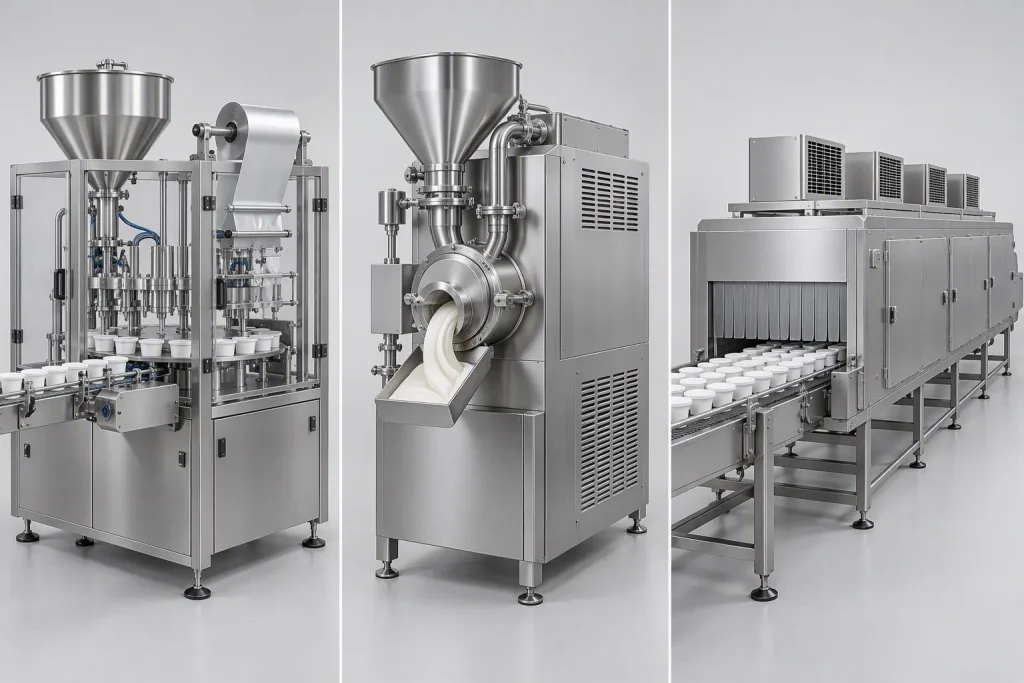
3. Freezing and Product Finishing
3.1 Continuous Ice Cream Freezer
Scraped-surface freezer converts aged mix into a smooth, aerated product. Independent control of mix flow, refrigeration and air dosing supports repeatable overrun and discharge temperature.
Typical output: 300–3,000 L/h per barrel. Options: automatic viscosity control, variable dasher speed, low-temperature kit and digital production records.
3.2 Fruit Feeder and Ripple Pump
Metering systems add fruit pieces, biscuit, nuts, chocolate or sauce with minimal product damage. Quick-release food-contact parts simplify allergen changeovers.
3.3 Batch Freezer Option
Flexible alternative for small runs, recipe development and premium gelato-style products. Suitable where frequent flavour changes are more important than continuous throughput.
4. Filling, Packaging and Cold Chain
4.1 Cup and Tub Filling/Sealing Machine
Indexes containers through denesting, filling, lidding, sealing and discharge. Servo-controlled dosing supports clean fills and rapid pack-size adjustment.
Typical speed: 1,500–12,000 packs/hour, dependent on size and configuration. Options: multi-flavour filling, lid sterilisation, date coding, checkweigher and metal detector.
4.2 Cone and Stick Lines
Purpose-built systems can dispense, decorate, insert sticks, chocolate-coat and wrap products. Selection depends on format, inclusions and required novelty shapes.
4.3 Hardening Tunnel
High-velocity low-temperature air rapidly removes heat after filling, stabilising structure before case packing. Spiral or straight-through designs are available according to floor space.
Indicative air temperature: −30 to −40°C. Options: automatic defrost, variable belt speed, insulated enclosure and evaporator redundancy.
4.4 Frozen Store
Maintains finished product under stable frozen conditions before dispatch. Include insulated panels, pallet layout, temperature monitoring, alarms and suitable refrigeration redundancy.
5. Cleaning, Utilities and Automation
5.1 Clean-in-Place System
Automated recovery or single-use CIP skid for pre-rinse, caustic wash, intermediate rinse, acid wash where required, final rinse and sanitisation. Conductivity, temperature, flow and return monitoring support verified cleaning.
5.2 Refrigeration Plant
Supplies chilled water or glycol for mix cooling, ageing and process duties, plus low-temperature refrigeration for freezing and hardening. Refrigerant choice, heat rejection and plant-room design must meet the site’s regulations and sustainability targets.
5.3 Steam/Hot Water, Air and Water
Utilities may include culinary steam or hygienic hot water, filtered compressed air, potable process water, softened boiler feed and controlled drainage. Final loads are confirmed after equipment selection.
5.4 Electrical and Control System
Central PLC/HMI control can manage recipes, valve routing, alarms, trend data, production reports and CIP sequences. Optional integration includes SCADA, batch traceability and remote service access subject to cybersecurity approval.
| Equipment Selection Schedule | ||
| Equipment | Primary function | Key selection data |
| Reception/storage tanks | Buffer chilled raw materials | Daily intake, holding time, tanker schedule |
| Mixing system | Disperse and hydrate ingredients | Batch size, powder rate, viscosity |
| Pasteuriser | Validated heat treatment | Flow, recipe, regeneration, hold duty |
| Homogeniser | Stabilise emulsion | Pressure, flow, fat content |
| Ageing vats | Cold maturation | Batch cadence, ageing time, buffer volume |
| Continuous freezer | Freeze and aerate | Output, overrun, discharge temperature |
| Filler/sealer | Pack finished product | Format, speed, dosing pattern |
| Hardening tunnel | Rapid final freezing | Pack heat load, dwell time, layout |
| CIP skid | Automated hygienic cleaning | Circuit volume, chemicals, recovery target |
6. Hygiene, Quality and Safety
- Food-contact surfaces selected for cleanability, corrosion resistance and recipe compatibility.
- Hygienic welds, drainable pipework and minimal product-retention zones.
- Validated pasteurisation controls with temperature recording and flow diversion as required.
- Physical guards, interlocks, emergency stops and lock-out provisions.
- Allergen management through segregated storage, verified cleaning and changeover procedures.
- Quality checks may include total solids, fat, pH, viscosity, overrun, draw temperature, pack weight, microbiology and sensory release.
Important: Final design, sanitation programme and operating limits must be reviewed by qualified food technologists, refrigeration specialists and local regulatory authorities.
7. Typical Supply Scope
Base supply: process equipment, hygienic piping within the agreed battery limits, control panels, operator manuals, factory testing and commissioning support.
Optional services: plant layout, utility design, installation supervision, operator training, recipe trials, spare-parts package, preventive maintenance and remote diagnostics.
Normally excluded unless specified: building works, main utility generation, laboratory equipment, forklifts, warehouse racking, primary power distribution and statutory permits.
8. Information Required for a Firm Quotation
- Target finished-product output per hour and operating hours per day.
- Recipes, fat/solids range, required overrun and inclusion size.
- Pack formats, fill weights and target packs per hour.
- Available utilities, refrigerant restrictions and local electrical standard.
- Room dimensions, access constraints and preferred equipment layout.
- Required automation, data recording and traceability level.
- Applicable food-safety, pressure-vessel and machinery standards.
Contact and Project Enquiry
STI FLOWS LTD
Email: [email protected]
Catalogue specifications are indicative and subject to detailed engineering. Images are illustrative and may show optional equipment.