
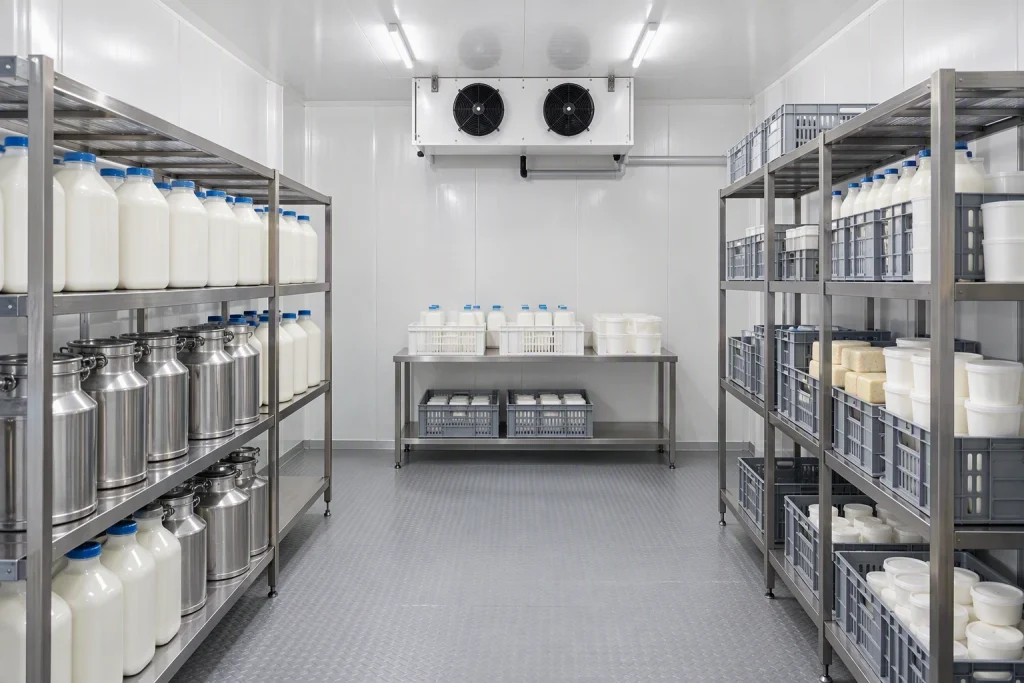
Concept Design: Milk Standardisation Plant with Two SS Tanks
1. Design Basis
This concept uses two hygienic stainless-steel tanks for batch milk standardisation. Final capacities, throughput, fat targets, and utility loads shall be confirmed during detailed design.
- Product: chilled raw or pasteurised milk
- Operation: batch receipt, blending, verification, and transfer
- Product-contact material: SS 316L; external non-contact parts may be SS 304
- Indicative tank construction: insulated, closed, vertical tanks with sloped bottoms
- Indicative design temperature: product service suitable for chilled milk and hot CIP circulation
2. Process Flow
Milk reception or upstream balance → Tank 1: receiving and blend preparation → controlled addition of cream or skim milk → agitation and sample verification → Tank 2: standardised milk holding → downstream pasteuriser, filler, or storage.
A sanitary transfer pump moves product between the tanks. A hygienic valve manifold separates product, drain, and CIP routes and prevents unintended mixing.
3. Tank Duties
Tank 1 — Milk Receiving and Standardisation Tank
- Receives the base milk and measured cream or skim milk.
- Fitted with a slow-speed hygienic agitator for uniform blending without excessive foaming.
- Includes load cells or a level transmitter, temperature indication, high-level protection, a sampling valve, spray device, vent filter, manway, and insulated jacket.
Tank 2 — Standardised Milk Holding Tank
- Receives the verified standardised milk batch.
- Provides gentle agitation and chilled holding before downstream processing.
- Includes level and temperature instruments, high- and low-level protection, a sampling valve, spray device, vent filter, manway, and insulated jacket.
4. Equipment Schedule
| Item | Qty. | Indicative specification |
| SS Tank 1 | 1 | SS 316L product contact, insulated, jacketed, hygienic agitator, CIP spray device |
| SS Tank 2 | 1 | SS 316L product contact, insulated, jacketed, hygienic agitator, CIP spray device |
| Sanitary transfer pump | 1 duty | Variable-speed centrifugal pump sized for required transfer rate and pressure drop |
| Dosing arrangement | 1 set | Metered cream and/or skim-milk addition with hygienic valves and flow measurement |
| Valve manifold and pipework | 1 set | Drainable hygienic pipework with separated product and CIP routes |
| Control panel | 1 | PLC/HMI with batch sequence, permissives, alarms, trends, and recipe control |
5. Controls and Interlocks
- Recipe entry for target batch quantity and fat percentage.
- Automatic calculation and metering of cream or skim-milk addition based on verified incoming composition.
- Agitator operation permitted only above the minimum safe product level.
- Transfer prevented on high level in the receiving tank or incorrect valve alignment.
- Low-level pump protection and high-high-level shutdown.
- Batch record for quantities, temperatures, operator actions, analytical result, and release status.
6. Hygienic and Utility Requirements
- Fully drainable product-contact surfaces, orbital-welded hygienic pipework, and minimal dead legs.
- Food-grade seals compatible with milk, cleaning chemicals, and operating temperatures.
- CIP coverage for both tanks, transfer line, dosing line, pump, and valve manifold; return conductivity and temperature monitoring are recommended.
- Utilities: chilled water or glycol, hot water/CIP supply, potable water, compressed air, electrical power, and drainage.
- Provide safe access to manways and instruments, bunding or controlled drainage where required, and suitable floor falls.
7. Inputs Required for Detailed Design
- Required plant throughput and batch size
- Working and gross capacity of each tank
- Incoming and target fat percentages
- Product inlet and outlet temperatures
- Required holding time and downstream process
- Applicable local food-safety, pressure-equipment, electrical, and building requirements
- Available CIP parameters and utility capacities
Note: This is a conceptual process brief. A qualified dairy process engineer shall complete the mass balance, hygienic risk review, mechanical design, instrumentation schedule, utility sizing, and regulatory compliance checks before fabrication or installation.